
Call now on0800 028 1700
or email:sales@fairwaysgm.com
Friday, 29 May 2026

For David McBride, the transformation of Bearsden Golf Club has been far more than simply a golf course construction project.
A long-time member of the East Dunbartonshire club as well as a qualified greenkeeper, golf course agronomist and construction specialist, he has spent almost two decades helping shape a vision which is now close to completion.
What began around 17 years ago as discussions surrounding the potential redevelopment of the club’s original nine-hole course — incorporating additional land adjacent to the UNESCO World Heritage Site of the Antonine Wall — has evolved into one of the most ambitious and technically complex projects in the club’s history.
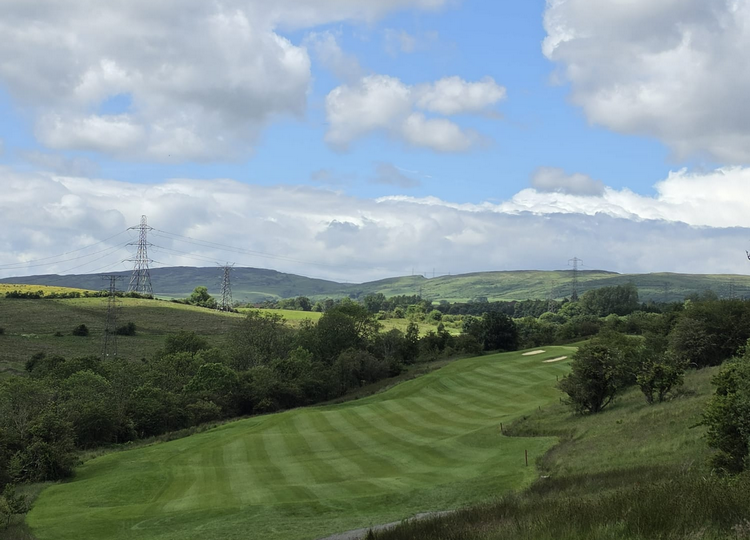
Years of planning considerations, environmental assessments and funding discussions meant progress was often gradual, but today the redevelopment is complete, with only final snagging works remaining.
The result is a dramatically reshaped and resilient golf course designed to serve generations of members to come.
“Originally, the ambition was to create a new 18-hole golf course, but ultimately the project evolved into a nine-hole layout — albeit one built to an exceptionally high standard,” explained David McBride.
Three years ago, David formally stepped into the role of Project Course Manager as plans moved from concept towards construction reality.
The redevelopment required far more than simply reshaping holes. With the site bordering the Antonine Wall corridor, the project involved extensive consultation and careful planning, including the rerouting of public footpaths, environmental considerations and the integration of additional land into the existing course layout.
Prior to the Bearsden redevelopment, David had enjoyed a long-standing professional relationship with golf course architect and constructor, Graeme Webster dating back to the early 1990s, when the pair first collaborated on the construction of a new golf course on Scotland's east coast. That project involved many of the same principles later adopted at Bearsden, including large-scale earthmoving, drainage installation and the construction of modern golf surfaces.
The experience and the mutual understanding developed over the decades, proved invaluable throughout the Bearsden redevelopment.
“We already understood each other's approach which was a huge advantage,” said David. “There was a level of trust which made a real difference so we could resolve any issues far faster.”
“We faced plenty of challenges during the project, particularly with the weather and the rerouting of public paths, but one thing we felt strongly about was building the course around the membership and remembering they still wanted to play golf throughout the construction period.
“It’s actually very rare for that to happen. Across my career I’ve now done it twice, but it’s certainly not the normal way of doing things.”
Throughout the redevelopment period, maintaining golf for members remained one of the club’s biggest priorities.
“We have around 500 members and are virtually full, so from the outset we wanted to ensure people could continue playing throughout the construction programme. What that meant in reality was a constantly evolving golf course with a mixture of old holes, newly completed holes and sometimes temporary ‘made-up’ holes just to keep nine in play.

“Admittedly, at times some of those layouts were a little rough and ready, but importantly our members were still able to get their golfing fix while the project progressed.”
The constantly changing nature of the course created significant challenges from a grow-in and maintenance perspective. With different greens and surfaces all sitting at varying stages of maturity, the agronomic management programme became highly complex, with support and advice provided by Turf Grass Science at various stages of the project.
“Some greens were newly constructed while others were already a year old, so we were dealing with completely different growing stages across the course,” he explained. “That meant different feeding programmes, different cutting regimes and different levels of maintenance depending on where you were working. It was difficult to stay on top of everything.
Recruitment also proved challenging during the project, particularly when trying to source experienced greenkeeping staff capable of working within such a specialised construction and grow-in environment.
“We brought additional people in to help where we could, but like much of the industry we found it difficult to recruit fully trained greenkeepers. What we tended to do was take the best people we could find and allocate them to straightforward cutting duties or simpler maintenance tasks, which allowed our experienced staff to focus on the more technical areas which required greater knowledge.”
At times, the scale of responsibility placed on the core team became enormous.
“Across the entire project there were really only two fully qualified greenkeepers involved day-to-day — me and former Head Greenkeeper John Brown,” he explained. “There were occasions where I found myself effectively acting as both the client and the contractor at the same time.
“When the greens had been shaped and prepared, I was often the person out there applying the fertiliser and then seeding every green individually myself. At that stage, you simply do whatever is required to keep the project moving forward.”
From a construction perspective, the project was designed to deliver long-term performance and consistency. Working alongside Graeme Webster, the new greens were built to an exceptionally high USGA specification, using a rootzone composition containing approximately 96 per cent sand and four per cent loam.
“It’s not uncommon for greens with around 70 per cent sand content to achieve USGA status, but at 96 per cent we are significantly beyond that,” said David McBride. “The trade-off is that they contain very little organic matter, so retaining nutrients becomes much more challenging.
“The sand-based profiles dry out very quickly, which is ideal for the west of Scotland climate.”
The project also incorporated extensive sand-capping works across the approaches and surrounds, with approximately 50 metres leading into greens constructed using 150mm-deep sand-based profiles to improve drainage, firmness and year-round playability.
“We’ve effectively sand-capped the tees, greens and approaches,” he added. “The only areas which weren’t sand-capped were the fairways.”
Attention to detail extended across every aspect of the construction process. All bunkers were installed using capillary concrete liners before being topped with carefully selected sand following extensive research into the most suitable sand profiles for use throughout the course.
Drainage infrastructure also formed a major part of the redevelopment. Alongside conventional field drainage systems, the course incorporates modern catch basin drainage technology more commonly associated with contemporary championship-level construction projects.
“If you look at modern golf courses now, you’ll often see lower collection areas with grid systems underneath,” said McBride. “When we get heavy rainfall, surface water immediately moves towards those catch basins where most of it is collected and transferred straight into the drainage network.
“We still have the conventional field drains taking water away, but the catch systems remove most of the volume almost immediately before the remainder filters into the wider drainage infrastructure.”
A major element of the redevelopment also centred around a pioneering Natural Flood Management scheme developed in partnership with East Dunbartonshire Council.
“We did a huge amount of work with the council because parts of Bearsden town had experienced repeated flooding issues over the years. Part of the wider project agreement was that we would introduce new pathways and help create a flood management system which would benefit the local community as well as the golf course itself.”
Working alongside engineering consultants JBA Consulting, the project team modelled the scale of water retention required before designing a substantial natural water management network throughout the site.
“Ultimately, we created a snake-shaped burn running through the course with a series of holding ponds branching away from it,” said David McBride. “During heavy rainfall events, floodwater moves into those ponds where it can be temporarily held back before being released gradually into the drainage system in a controlled way.
“It’s a very impressive setup. There are lots of small ponds positioned strategically around the site which catch and store floodwater, slowing everything down before it eventually feeds back into the wider drainage infrastructure.”
The scheme was developed in consultation with SEPA and reflects the increasing pressure placed on drainage infrastructure in expanding residential areas.
“Like many places which have seen significant housing growth, parts of Bearsden have infrastructure which can struggle to cope during major rainfall events,” he said. “This project was designed to help address some of those pressures while also improving the golf course environment.”
Years of planning considerations, environmental assessments and funding discussions meant progress was often gradual. David is also keen to acknowledge the contribution of Gordon Thomson, Chairman of the Redevelopment Committee, who played a key role in helping steer the project from concept through to delivery.
The scale of the investment extended well beyond the playing surfaces. Bearsden also installed a £500,000 irrigation system capable of watering the entire golf course, including greens, tees, approaches and fairways.
Importantly, the club also developed its own borehole water supply, drilling between 60 and 70 metres below ground to create a sustainable long-term irrigation source.
“We can irrigate the whole course if we need to. Because we have our own borehole system, we are effectively recycling our own water supply which was a very important part of the long-term thinking behind the project.”
Environmental enhancement and habitat creation were equally central to the redevelopment philosophy, with approximately £500,000 invested into native shrubs and ecological improvements throughout the site.
Construction work itself was not without significant setbacks. Early in the project, the area experienced what McBride describes as the largest recorded rainfall event locally during 2023 — arriving just after the final greens had been seeded.
“We’d literally just seeded the last few greens when the storms hit,” he recalled. “At that stage, we also had road construction work underway around the course, so the timing couldn’t really have been much worse.”
Despite the challenges, all newly constructed USGA greens have now been in full play since April 2026, and the project is effectively nearing completion.
The redevelopment has also coincided with a new approach to course maintenance equipment, with the club recently investing in a modern machinery fleet supplied by Ransomes Jacobsen’s exclusive Scottish dealer, Fairways GM at Renfrew, to support the next chapter in Bearsden’s evolution.

“Fairways are new to us, but I was aware of them. I knew some of their people; they are absolutely the right choice to partner us into this new era.”
Alongside a focus on presentation quality and operational efficiency, the investment has also embraced quieter and lower-emission technology, including the introduction of electric Jacobsen mowing equipment better suited to the club’s modernised surfaces and environmentally conscious direction.
“For us, the project was never simply about rebuilding holes,” said David McBride. “It was about creating a golf course and maintenance operation properly equipped for the future, and the machinery investment forms part of that wider thinking.”
Recognition for the scale and quality of the redevelopment arrived earlier this year when Bearsden Golf Club was shortlisted in the prestigious BIGGA Greenkeeping Project of the Year Awards in January 2026.
“A huge amount of work has gone into this project over many years, but now that we are almost there, I genuinely believe the course is future proofed for generations to come,” said David.
While much of the day-to-day responsibility fell on a small core team, the redevelopment was supported by former Head Greenkeeper John Brown, the wider greenkeeping staff, club committees, consultants, contractors, East Dunbartonshire Council and the many members who remained committed to the project throughout its development.
Their collective efforts helped transform an ambitious plan into the course seen today.
Gallery